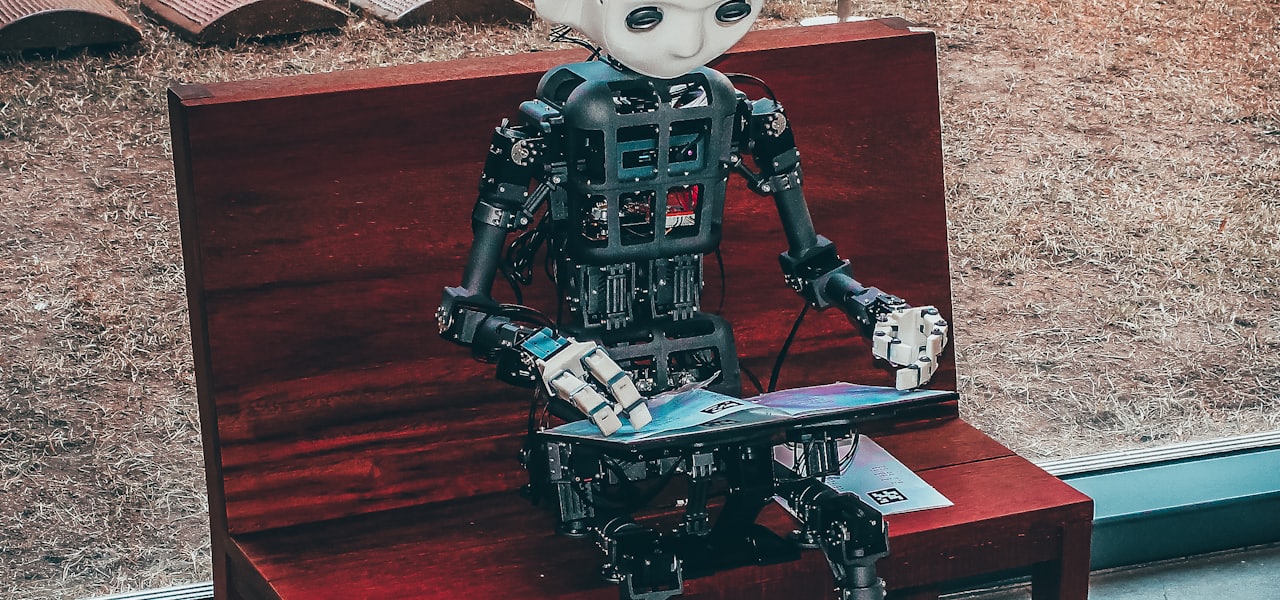
In artificial intelligence, an intelligent agent is an entity that perceives its environment, takes actions autonomously to achieve goals, and may improve its performance through machine learning or by acquiring knowledge. AI textbooks define artificial intelligence as the "study and design of intelligent agents," emphasizing that goal-directed behavior is central to intelligence. A specialized subset of intelligent agents, agentic AI (also known as an AI agent or simply agent), expands this concept by proactively pursuing goals, making decisions, and taking actions over extended periods. Intelligent agents can range from simple to highly complex. A basic thermostat or control system is considered an intelligent agent, as is a human being, or any other system that meets the same criteria—such as a firm, a state, or a biome. Intelligent agents operate based on an objective function, which encapsulates their goals. They are designed to create and execute plans that maximize the expected value of this function upon completion. For example, a reinforcement learning agent has a reward function, which allows programmers to shape its desired behavior. Similarly, an evolutionary algorithm's behavior is guided by a fitness function. Intelligent agents in artificial intelligence are closely related to agents in economics, and versions of the intelligent agent paradigm are studied in cognitive science, ethics, and the philosophy of practical reason, as well as in many interdisciplinary socio-cognitive modeling and computer social simulations. Intelligent agents are often described schematically as abstract functional systems similar to computer programs . To distinguish theoretical models from real-world implementations, abstract descriptions of intelligent agents are called abstract intelligent agents. Intelligent agents are also closely related to software agents—autonomous computer programs that carry out tasks on behalf of users. They are also referred to using a term borrowed from economics: a "rational agent". == Intelligent agents as the foundation of AI == The concept of intelligent agents provides a foundational lens through which to define and understand artificial intelligence. For instance, the influential textbook Artificial Intelligence: A Modern Approach (Russell & Norvig) describes: Agent: Anything that perceives its environment (using sensors) and acts upon it (using actuators). E.g., a robot with cameras and wheels, or a software program that reads data and makes recommendations. Rational Agent: An agent that strives to achieve the best possible outcome based on its knowledge and past experiences. "Best" is defined by a performance measure – a way of evaluating how well the agent is doing. Artificial Intelligence (as a field): The study and creation of these rational agents. Other researchers and definitions build upon this foundation. Padgham & Winikoff emphasize that intelligent agents should react to changes in their environment in a timely way, proactively pursue goals, and be flexible and robust (able to handle unexpected situations). Some also suggest that ideal agents should be "rational" in the economic sense (making optimal choices) and capable of complex reasoning, like having beliefs, desires, and intentions (BDI model). Kaplan and Haenlein offer a similar definition, focusing on a system's ability to understand external data, learn from that data, and use what is learned to achieve goals through flexible adaptation. Defining AI in terms of intelligent agents offers several key advantages: Avoids Philosophical Debates: It sidesteps arguments about whether AI is "truly" intelligent or conscious, like those raised by the Turing test or Searle's Chinese Room. It focuses on behavior and goal achievement, not on replicating human thought. Objective Testing: It provides a clear, scientific way to evaluate AI systems. Researchers can compare different approaches by measuring how well they maximize a specific "goal function" (or objective function). This allows for direct comparison and combination of techniques. Interdisciplinary Communication: It creates a common language for AI researchers to collaborate with other fields like mathematical optimization and economics, which also use concepts like "goals" and "rational agents." == Objective function == An objective function (or goal function) specifies the goals of an intelligent agent. An agent is deemed more intelligent if it consistently selects actions that yield outcomes better aligned with its objective function. In effect, the objective function serves as a measure of success. The objective function may be: Simple: For example, in a game of Go, the objective function might assign a value of 1 for a win and 0 for a loss. Complex: It might require the agent to evaluate and learn from past actions, adapting its behavior based on patterns that have proven effective. The objective function encapsulates all of the goals the agent is designed to achieve. For rational agents, it also incorporates the trade-offs between potentially conflicting goals. For instance, a self-driving car's objective function might balance factors such as safety, speed, and passenger comfort. Different terms are used to describe this concept, depending on the context. These include: Utility function: Often used in economics and decision theory, representing the desirability of a state. Objective function: A general term used in optimization. Loss function: Typically used in machine learning, where the goal is to minimize the loss (error). Reward Function: Used in reinforcement learning. Fitness Function: Used in evolutionary systems. Goals, and therefore the objective function, can be: Explicitly defined: Programmed directly into the agent. Induced: Learned or evolved over time. In reinforcement learning, a "reward function" provides feedback, encouraging desired behaviors and discouraging undesirable ones. The agent learns to maximize its cumulative reward. In evolutionary systems, a "fitness function" determines which agents are more likely to reproduce. This is analogous to natural selection, where organisms evolve to maximize their chances of survival and reproduction. Some AI systems, such as nearest-neighbor, reason by analogy rather than being explicitly goal-driven. However, even these systems can have goals implicitly defined within their training data. Such systems can still be benchmarked by framing the non-goal system as one whose "goal" is to accomplish its narrow classification task. Systems not traditionally considered agents, like knowledge-representation systems, are sometimes included in the paradigm by framing them as agents with a goal of, for example, answering questions accurately. Here, the concept of an "action" is extended to encompass the "act" of providing an answer. As a further extension, mimicry-driven systems can be framed as agents optimizing a "goal function" based on how closely the agent mimics the desired behavior. In generative adversarial networks (GANs) of the 2010s, an "encoder"/"generator" component attempts to mimic and improvise human text composition. The generator tries to maximize a function representing how well it can fool an antagonistic "predictor"/"discriminator" component. While symbolic AI systems often use an explicit goal function, the paradigm also applies to neural networks and evolutionary computing. Reinforcement learning can generate intelligent agents that appear to act in ways intended to maximize a "reward function". Sometimes, instead of setting the reward function directly equal to the desired benchmark evaluation function, machine learning programmers use reward shaping to initially give the machine rewards for incremental progress. Yann LeCun stated in 2018, "Most of the learning algorithms that people have come up with essentially consist of minimizing some objective function." AlphaZero chess had a simple objective function: +1 point for each win, and -1 point for each loss. A self-driving car's objective function would be more complex. Evolutionary computing can evolve intelligent agents that appear to act in ways intended to maximize a "fitness function" influencing how many descendants each agent is allowed to leave. The mathematical formalism of AIXI was proposed as a maximally intelligent agent in this paradigm. However, AIXI is uncomputable. In the real world, an intelligent agent is constrained by finite time and hardware resources, and scientists compete to produce algorithms that achieve progressively higher scores on benchmark tests with existing hardware. == Agent function == An intelligent agent's behavior can be described mathematically by an agent function. This function determines what the agent does based on what it has seen. A percept refers to the agent's sensory inputs at a single point in time. For example, a self-driving car's percepts might include camera images, lidar data, GPS coordinates, and speed r
Clubdjpro
ClubDJPro (often referred to as ClubDJ) is a DJ console and video mixing tool developed by Cube Software Solutions Inc. software. It was released in June 2005. == User interface == ClubDJPro has a GUI that was designed to allow aesthetic revisions via Skins. The skin engine that ClubDJPro uses allows for the ability to expand the software to take up the entire screen. As of 4.4.3.3 there are 3 user changeable skins included in the program which are changeable in the preferences tab. They are called 'AquaLung', 'Eleanor', and 'Grabber'. == Editions == ClubDJPro is available in two different editions, with separate features depending upon their target consumer group. DJ Edition - Can play audio files only. VJ Edition - Contains all of the features of the DJ Edition, in addition to support for video, karaoke, and visualizations. == Supported MIDI Controllers == Supported since version 2.0: Hercules Console Hercules Console MK2 Hercules Control MP3 PCDJ DAC-2 Controller == History == The initial "final release" of ClubDJPro was released on June 24, 2005. On June 26, 2009, the 4th iteration of the ClubDJPro software was released. The development of the software and website appears to have halted. As of March 2018 the website continues to show a new version "Coming Spring 2016".
Agent Ruby
Agent Ruby (1998–2002) by Lynn Hershman Leeson is an interactive, multiuser work using artificial intelligence. == Description == On Agent Ruby's website, "Agent Ruby's Edream Portal," a female face moves her eyes and lips. Ruby, named from Hershman Leeson's own film, Teknolust, answers questions and often responds that she needs a better algorithm to answer questions not within her database. The work, created with AI, explores relationships between real and virtual worlds. Hershman Leeson had created an earlier version of Ruby, CyberRoberta, which was a custom-made doll with webcam eyes that interacted with the internet. The work in a gallery provides a screen and a sign inviting gallery-goers to "Chat with Ruby." == Artificial intelligence == In 2015 when Agent Ruby was exhibited at the gallery Modern Art Oxford, a review in Aesthetica Magazine described it as an artificial intelligence agent. A review in New Scientist noted that "Ruby is a fast learner, but perhaps not a natural conversationalist." A 2024 list of "25 Essential AI Artworks" published by ARTnews wrote that while "Agent Ruby's capabilities seem limited by today's standards," it was extensive for its day. == Publications and exhibitions == Agent Ruby was commissioned and displayed at the San Francisco Museum of Modern Art, Modern Art Oxford, and the ZKM Center for Art and Media in Karlsruhe, Germany. The San Francisco Museum of Modern Art (SFMOMA) presented Lynn Hershman Leeson: The Agent Ruby Files, March 30 through June 2, 2013 which presented the project server's archive of user conversations over the 12 years of exhibitions.
Scale-space axioms
In image processing and computer vision, a scale space framework can be used to represent an image as a family of gradually smoothed images. This framework is very general and a variety of scale space representations exist. A typical approach for choosing a particular type of scale space representation is to establish a set of scale-space axioms, describing basic properties of the desired scale-space representation and often chosen so as to make the representation useful in practical applications. Once established, the axioms narrow the possible scale-space representations to a smaller class, typically with only a few free parameters. A set of standard scale space axioms, discussed below, leads to the linear Gaussian scale-space, which is the most common type of scale space used in image processing and computer vision. == Scale space axioms for the linear scale-space representation == The linear scale space representation L ( x , y , t ) = ( T t f ) ( x , y ) = g ( x , y , t ) ∗ f ( x , y ) {\displaystyle L(x,y,t)=(T_{t}f)(x,y)=g(x,y,t)f(x,y)} of signal f ( x , y ) {\displaystyle f(x,y)} obtained by smoothing with the Gaussian kernel g ( x , y , t ) {\displaystyle g(x,y,t)} satisfies a number of properties 'scale-space axioms' that make it a special form of multi-scale representation: linearity T t ( a f + b h ) = a T t f + b T t h {\displaystyle T_{t}(af+bh)=aT_{t}f+bT_{t}h} where f {\displaystyle f} and h {\displaystyle h} are signals while a {\displaystyle a} and b {\displaystyle b} are constants, shift invariance T t S ( Δ x , Δ y ) f = S ( Δ x , Δ y ) T t f {\displaystyle T_{t}S_{(\Delta x,\Delta _{y})}f=S_{(\Delta x,\Delta _{y})}T_{t}f} where S ( Δ x , Δ y ) {\displaystyle S_{(\Delta x,\Delta _{y})}} denotes the shift (translation) operator ( S ( Δ x , Δ y ) f ) ( x , y ) = f ( x − Δ x , y − Δ y ) {\displaystyle (S_{(\Delta x,\Delta _{y})}f)(x,y)=f(x-\Delta x,y-\Delta y)} semi-group structure g ( x , y , t 1 ) ∗ g ( x , y , t 2 ) = g ( x , y , t 1 + t 2 ) {\displaystyle g(x,y,t_{1})g(x,y,t_{2})=g(x,y,t_{1}+t_{2})} with the associated cascade smoothing property L ( x , y , t 2 ) = g ( x , y , t 2 − t 1 ) ∗ L ( x , y , t 1 ) {\displaystyle L(x,y,t_{2})=g(x,y,t_{2}-t_{1})L(x,y,t_{1})} existence of an infinitesimal generator A {\displaystyle A} ∂ t L ( x , y , t ) = ( A L ) ( x , y , t ) {\displaystyle \partial _{t}L(x,y,t)=(AL)(x,y,t)} non-creation of local extrema (zero-crossings) in one dimension, non-enhancement of local extrema in any number of dimensions ∂ t L ( x , y , t ) ≤ 0 {\displaystyle \partial _{t}L(x,y,t)\leq 0} at spatial maxima and ∂ t L ( x , y , t ) ≥ 0 {\displaystyle \partial _{t}L(x,y,t)\geq 0} at spatial minima, rotational symmetry g ( x , y , t ) = h ( x 2 + y 2 , t ) {\displaystyle g(x,y,t)=h(x^{2}+y^{2},t)} for some function h {\displaystyle h} , scale invariance g ^ ( ω x , ω y , t ) = h ^ ( ω x φ ( t ) , ω x φ ( t ) ) {\displaystyle {\hat {g}}(\omega _{x},\omega _{y},t)={\hat {h}}({\frac {\omega _{x}}{\varphi (t)}},{\frac {\omega _{x}}{\varphi (t)}})} for some functions φ {\displaystyle \varphi } and h ^ {\displaystyle {\hat {h}}} where g ^ {\displaystyle {\hat {g}}} denotes the Fourier transform of g {\displaystyle g} , positivity g ( x , y , t ) ≥ 0 {\displaystyle g(x,y,t)\geq 0} , normalization ∫ x = − ∞ ∞ ∫ y = − ∞ ∞ g ( x , y , t ) d x d y = 1 {\displaystyle \int _{x=-\infty }^{\infty }\int _{y=-\infty }^{\infty }g(x,y,t)\,dx\,dy=1} . In fact, it can be shown that the Gaussian kernel is a unique choice given several different combinations of subsets of these scale-space axioms: most of the axioms (linearity, shift-invariance, semigroup) correspond to scaling being a semigroup of shift-invariant linear operator, which is satisfied by a number of families integral transforms, while "non-creation of local extrema" for one-dimensional signals or "non-enhancement of local extrema" for higher-dimensional signals are the crucial axioms which relate scale-spaces to smoothing (formally, parabolic partial differential equations), and hence select for the Gaussian. The Gaussian kernel is also separable in Cartesian coordinates, i.e. g ( x , y , t ) = g ( x , t ) g ( y , t ) {\displaystyle g(x,y,t)=g(x,t)\,g(y,t)} . Separability is, however, not counted as a scale-space axiom, since it is a coordinate dependent property related to issues of implementation. In addition, the requirement of separability in combination with rotational symmetry per se fixates the smoothing kernel to be a Gaussian. There exists a generalization of the Gaussian scale-space theory to more general affine and spatio-temporal scale-spaces. In addition to variabilities over scale, which original scale-space theory was designed to handle, this generalized scale-space theory also comprises other types of variabilities, including image deformations caused by viewing variations, approximated by local affine transformations, and relative motions between objects in the world and the observer, approximated by local Galilean transformations. In this theory, rotational symmetry is not imposed as a necessary scale-space axiom and is instead replaced by requirements of affine and/or Galilean covariance. The generalized scale-space theory leads to predictions about receptive field profiles in good qualitative agreement with receptive field profiles measured by cell recordings in biological vision. In the computer vision, image processing and signal processing literature there are many other multi-scale approaches, using wavelets and a variety of other kernels, that do not exploit or require the same requirements as scale space descriptions do; please see the article on related multi-scale approaches. There has also been work on discrete scale-space concepts that carry the scale-space properties over to the discrete domain; see the article on scale space implementation for examples and references.
Language resource
In linguistics and language technology, a language resource is a "[composition] of linguistic material used in the construction, improvement and/or evaluation of language processing applications, (...) in language and language-mediated research studies and applications." According to Bird & Simons (2003), this includes data, i.e. "any information that documents or describes a language, such as a published monograph, a computer data file, or even a shoebox full of handwritten index cards. The information could range in content from unanalyzed sound recordings to fully transcribed and annotated texts to a complete descriptive grammar", tools, i.e., "computational resources that facilitate creating, viewing, querying, or otherwise using language data", and advice, i.e., "any information about what data sources are reliable, what tools are appropriate in a given situation, what practices to follow when creating new data". The latter aspect is usually referred to as "best practices" or "(community) standards". In a narrower sense, language resource is specifically applied to resources that are available in digital form, and then, "encompassing (a) data sets (textual, multimodal/multimedia and lexical data, grammars, language models, etc.) in machine readable form, and (b) tools/technologies/services used for their processing and management". == Typology == As of May 2020, no widely used standard typology of language resources has been established (current proposals include the LREMap, METASHARE, and, for data, the LLOD classification). Important classes of language resources include data lexical resources, e.g., machine-readable dictionaries, linguistic corpora, i.e., digital collections of natural language data, linguistic data bases such as the Cross-Linguistic Linked Data collection, tools linguistic annotations and tools for creating such annotations in a manual or semiautomated fashion (e.g., tools for annotating interlinear glossed text such as Toolbox and FLEx, or other language documentation tools), applications for search and retrieval over such data (corpus management systems), for automated annotation (part-of-speech tagging, syntactic parsing, semantic parsing, etc.), metadata and vocabularies vocabularies, repositories of linguistic terminology and language metadata, e.g., MetaShare (for language resource metadata), the ISO 12620 data category registry (for linguistic features, data structures and annotations within a language resource), or the Glottolog database (identifiers for language varieties and bibliographical database). == Language resource publication, dissemination and creation == A major concern of the language resource community has been to develop infrastructures and platforms to present, discuss and disseminate language resources. Selected contributions in this regard include: a series of International Conferences on Language Resources and Evaluation (LREC), the European Language Resources Association (ELRA, EU-based), and the Linguistic Data Consortium (LDC, US-based), which represent commercial hosting and dissemination platforms for language resources, the Open Languages Archives Community (OLAC), which provides and aggregates language resource metadata, the Language Resources and Evaluation Journal (LREJ), the European Language Grid is a European platform for language technologies (eg services), data and resources. As for the development of standards and best practices for language resources, these are subject of several community groups and standardization efforts, including ISO Technical Committee 37: Terminology and other language and content resources (ISO/TC 37), developing standards for all aspects of language resources, W3C Community Group Best Practices for Multilingual Linked Open Data (BPMLOD), working on best practice recommendations for publishing language resources as Linked Data or in RDF, W3C Community Group Linked Data for Language Technology (LD4LT), working on linguistic annotations on the web and language resource metadata, W3C Community Group Ontology-Lexica (OntoLex), working on lexical resources, the Open Linguistics working group of the Open Knowledge Foundation, working on conventions for publishing and linking open language resources, developing the Linguistic Linked Open Data cloud, the Text Encoding Initiative (TEI), working on XML-based specifications for language resources and digitally edited text.
BLOOM (language model)
The BigScience Large Open-science Open-access Multilingual Language Model (BLOOM) is an open-access large language model (LLM) released in 2022. It was created by a volunteer-driven research effort to provide a transparently-created alternative to proprietary AI models. With 176 billion parameters, BLOOM is a transformer-based autoregressive model designed to generate text in 46 natural languages and 13 programming languages. The model is distributed under the project's "Responsible AI License". == Development == BLOOM is the main outcome of the BigScience initiative, a one-year-long research workshop. The project was coordinated by Hugging Face using funding from the French government and involved several hundred volunteer researchers and engineers from academia and the private sector. The model was trained between March and July 2022 on the Jean Zay public supercomputer in France, managed by GENCI and IDRIS (CNRS). Unlike GPT-3, BLOOM was trained to be multilingual. The source code is released under the Apache 2.0 license. The model's parameters are released under BigScience's "Responsible AI License" (RAIL), which grants open access and reuse rights but with some usage restrictions. BLOOM was used in the chatbots BLOOMChat and HuggingChat due to its multilingual abilities. BLOOM's training corpus, named ROOTS, combines data extracted from the then-latest version of the web-based OSCAR corpus (38% of ROOTS) and newly collected data extracted from a manually selected and documented list of language data sources. In total, the model was trained on approximately 366 billion (1.6TB) tokens. It was developed using the open-source libraries DeepSpeed Megatron. BigScience then released xP3, a multilingual dataset for LLM supervised learning. It also released BLOOMZ, a variant of BLOOM fine-tuned on xP3 to follow instructions.
Corpus of Linguistic Acceptability
Corpus of Linguistic Acceptability (CoLA) is a dataset the primary purpose of which is to serve as a benchmark for evaluating the ability of artificial neural networks, including large language models, to judge the grammatical correctness of sentences. It consists of 10,657 English sentences from published linguistics literature that were manually labeled either as grammatical or ungrammatical. == Public version == The publicly available version of CoLA contains 9,594 sentences that belong to training and development sets. It excludes 1,063 sentences reserved for a held-out test set.